
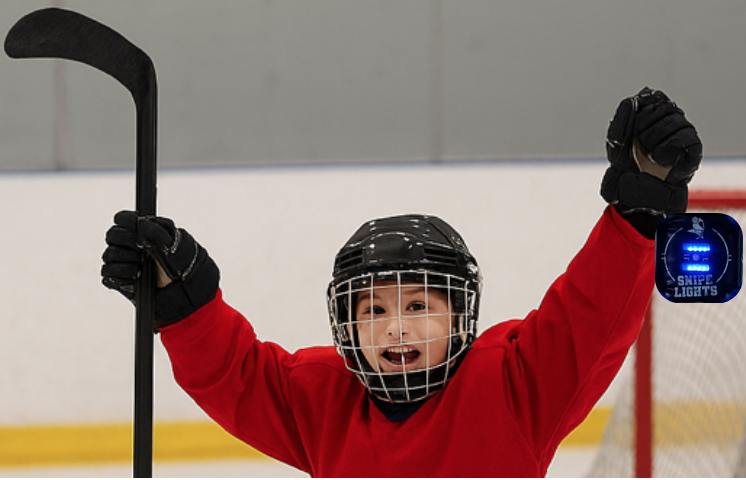
If you’ve ever watched a young player get frustrated during shooting practice, you know how quickly things can go downhill. A few missed shots, static targets that don’t add enough challenge, and a drill that feels repetitive can turn a motivated kid into one who suddenly “feels tired” or wants to call it a day. Confidence and focus, especially in the early years, are fragile.
But something interesting happens when you introduce training methods that feel more like a game than a chore. Light-up targets, reaction-time challenges, audio cues, and high scores suddenly flip that emotional switch. Kids go from “Ugh, do I have to?” to “Wait, I can beat that score. One more round.” Snipe Lights, a hockey shooting video game, uses this kind of gamification and positive reinforcement.
This isn’t about gimmicks—it’s about psychology, learning science, and the way young athletes respond to feedback and challenge. Looking closer, the “fun” elements are actually powerful teaching tools.
Why Confidence Matters More Than Perfect Form
Coaches and parents understandably focus on mechanics: hand placement, weight transfer, stick path, follow-through. But kids don’t stick with shooting drills because of mechanics—they stick with them because of confidence.
A confident young player:
- Attempts more shots
- Stays relaxed, which improves mechanics automatically
- Learns from mistakes instead of shutting down
- Feels proud of measurable improvement
- Associates practice with positive feelings rather than pressure
Confidence isn’t just a mental boost; it’s foundational to development. And the best way to build confidence is through experiences that deliver consistent, immediate success—followed by achievable challenges.
That’s where a game-like training environment becomes so effective.
How “Games” Create Real Skill
Gamified training—anything that incorporates progressive goals, visual feedback, or scoring—taps into the same motivational systems that make kids (and adults) enjoy video games. It’s not because kids are “screen addicted.” It’s because games follow learning principles that traditional drills often ignore.
Let’s break down the three biggest:
1. Immediate Feedback Strengthens Motor Learning
Feedback is how the brain learns physical skills. When a young player takes a shot and immediately sees a target light up or hears a sound, that instant response tells their brain:
- You hit it.
- That worked.
- Repeat that motion again.
This is reinforcement learning in action. It’s the same process the brain uses to learn piano notes, basketball free-throws, and even handwriting. The quicker the feedback, the stronger the connection between action and outcome.
Compare that with shooting at a static bullseye taped to the garage. Hit or miss, the brain receives almost no “signal,” so the learning loop closes much more slowly.
2. Challenge Levels Keep Players in the “Zone”
Psychologists call it the flow state: a perfect balance between difficulty and ability. Too easy and the player gets bored. Too hard and they get frustrated.
Interactive target systems naturally create this balanced progression:
- Targets can light up in unpredictable patterns
- Reaction times may speed up
- The child may try to beat a previous high score
3. Structured Wins Build Confidence Quickly
When a child sees their score increase by even a small amount—like from 10 hits to 13—that measurable progress becomes a confidence anchor. Progress is no longer abstract; it’s visible, trackable, and earned.
This is the power of progress, a motivational force well-documented in sports psychology and education research. Humans—especially kids—are deeply motivated by small, consistent wins. It’s why leveling systems in games are so compelling and why beating high scores feels satisfying.
But here’s the crucial part: those small wins encourage more practice, and more practice leads to better mechanics, stronger technique, and real skill development.
Beating High Scores: A Simple Tool With Big Effects
One of the most effective features of gamified training is the “high score.” It seems so simple, but it creates a training mindset that’s incredibly powerful.
High scores do three important things:
1. They shift the focus from “Get it right” to “Get better.”
Traditional shooting drills can feel like a pass/fail test. You hit the target, or you didn’t. Kids internalize misses as failure, which chips away at confidence.
A high score reframes the goal:
- Can you hit one more?
- Can you do it a little faster?
- Can you stay focused for 60 seconds instead of 30?
This turns practice into self-improvement rather than perfection.
2. They make practice internally motivating.
When kids chase their own best score, they’re no longer practicing because a coach or parent told them to—they’re practicing because they want to. That autonomy is a huge predictor of long-term athlete engagement.
3. They redefine “failure” as part of the challenge.
Miss a shot? No problem. There’s another round. Another score to beat. Mistakes become part of the game rather than something to be embarrassed about.
The Role of Fun Sounds and Celebration Cues
To an adult, a beep, ding, or celebratory sound effect might just seem like a cute add-on. But for kids, sound is a powerful reinforcement tool:
- It signals success
- It builds anticipation
- It rewards accuracy
- It makes practice memorable
- It activates the same reward pathways used in games
Just like how teachers use bells, rhythms, or auditory cues to improve learning, fun sounds provide an additional layer of motivation. They keep players engaged longer, which means they get in more repetitions—and those repetitions directly contribute to improved confidence and skill.
Why This Matters for Struggling or Hesitant Players
Not every kid is a naturally confident shooter. Some hold back because:
- They don’t want to be watched while practicing
- They’re afraid of messing up
- They learn slower than teammates
- They compare themselves to others
- The fundamentals feel overwhelming
Gamified training removes a lot of those barriers. There’s no audience, no pressure, no coach hovering over their shoulder. It’s just them and a challenge they can approach at their own pace.
When they finally hit a target or beat a score on their own, the confidence boost is real—and it spills over into team practices, games, and everyday attitude.
The Big Picture: Confidence First, Skills Second
It may seem backwards, but for young players, confidence leads to skill—not the other way around. When a child feels successful, they try more. When they try more, they learn more. And when they learn more, their mechanics naturally improve.
Gamified shooting systems like Snipe Lights simply give kids more opportunities to win early, win often, and enjoy the learning process.
And that enjoyment transforms everything.
Related links:
How Interactive Hockey Training Targets Can Transform Backyard, Driveway, or Basement Practice
A Perfect NHL Playoff Goal Shows Why You Should Use Snipe Lights